
How to Prepare Your Product Data for the Age of Agentic Commerce
March 6, 2026 · 10 min read
(Or: How to Stop Feeding Your Catalog After Midnight)
More and more posts about “AI agents are going to shop for us.” Most of these posts offer dire warnings and little else. That’s like shouting “Winter is coming!” while standing in a T-shirt and never mentioning coats.
So let’s talk about the stuff that actually helps.
The shift: from “browse and click” to “ask and decide”
Traditional e-commerce is a shopping mall. The customer wanders, compares storefronts, reads signage, asks a clerk.
Agentic commerce is different. It’s more like sending a very literal, very impatient intern to run an errand with strict instructions: Get me the right thing. Get it fast. Don’t make me think. Don’t embarrass me.
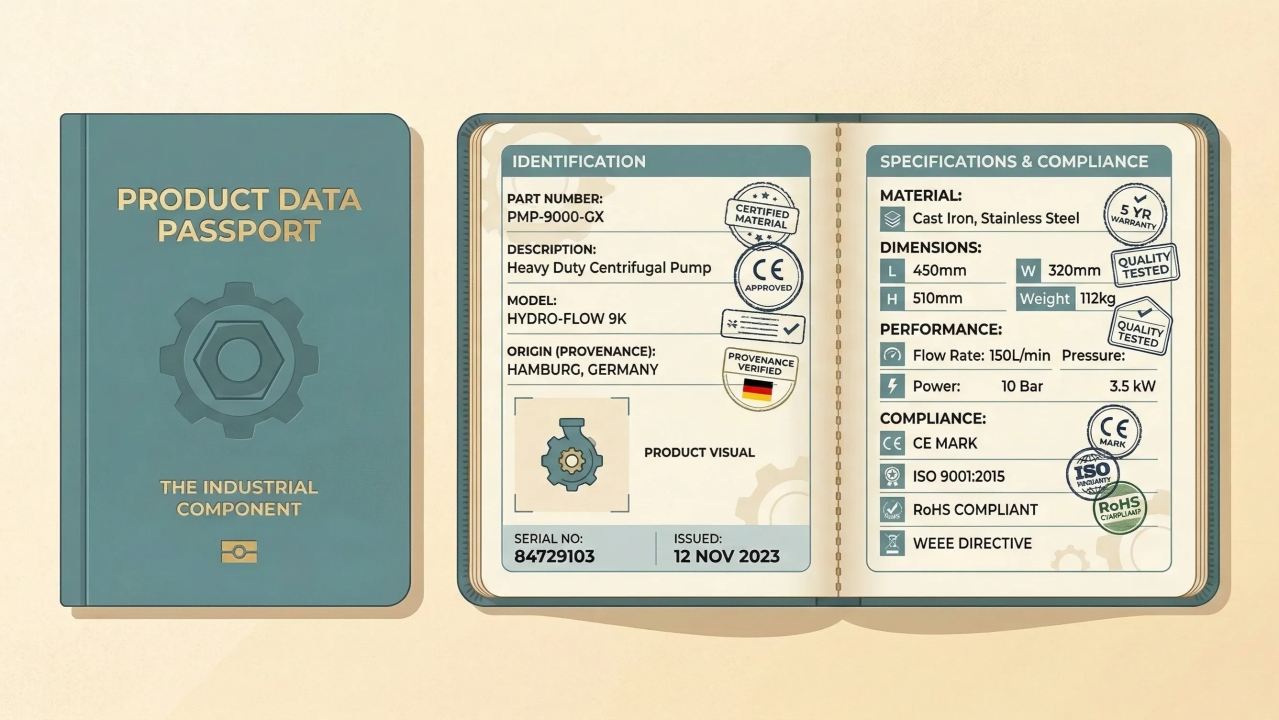
The infrastructure for this is already being built. OpenAI has framed “agentic commerce primitives,” which are ways for agents, businesses, and users to coordinate purchasing flows. Google is pushing an open standard (UCP) for agents to interact across discovery, checkout, and post-purchase. GS1 Digital Link is creating product identifiers that resolve to the right digital resources for any given item — a universal passport system for products.
Whether checkout happens “inside chat” or elsewhere, the requirement doesn’t change:
Agents need product truth that’s computable.
If your product data is fuzzy, inconsistent, or trapped in PDFs, an agent doesn’t “struggle.” It simply moves on. In B2B, moving on isn’t a vibe, it’s a PO number you never see.
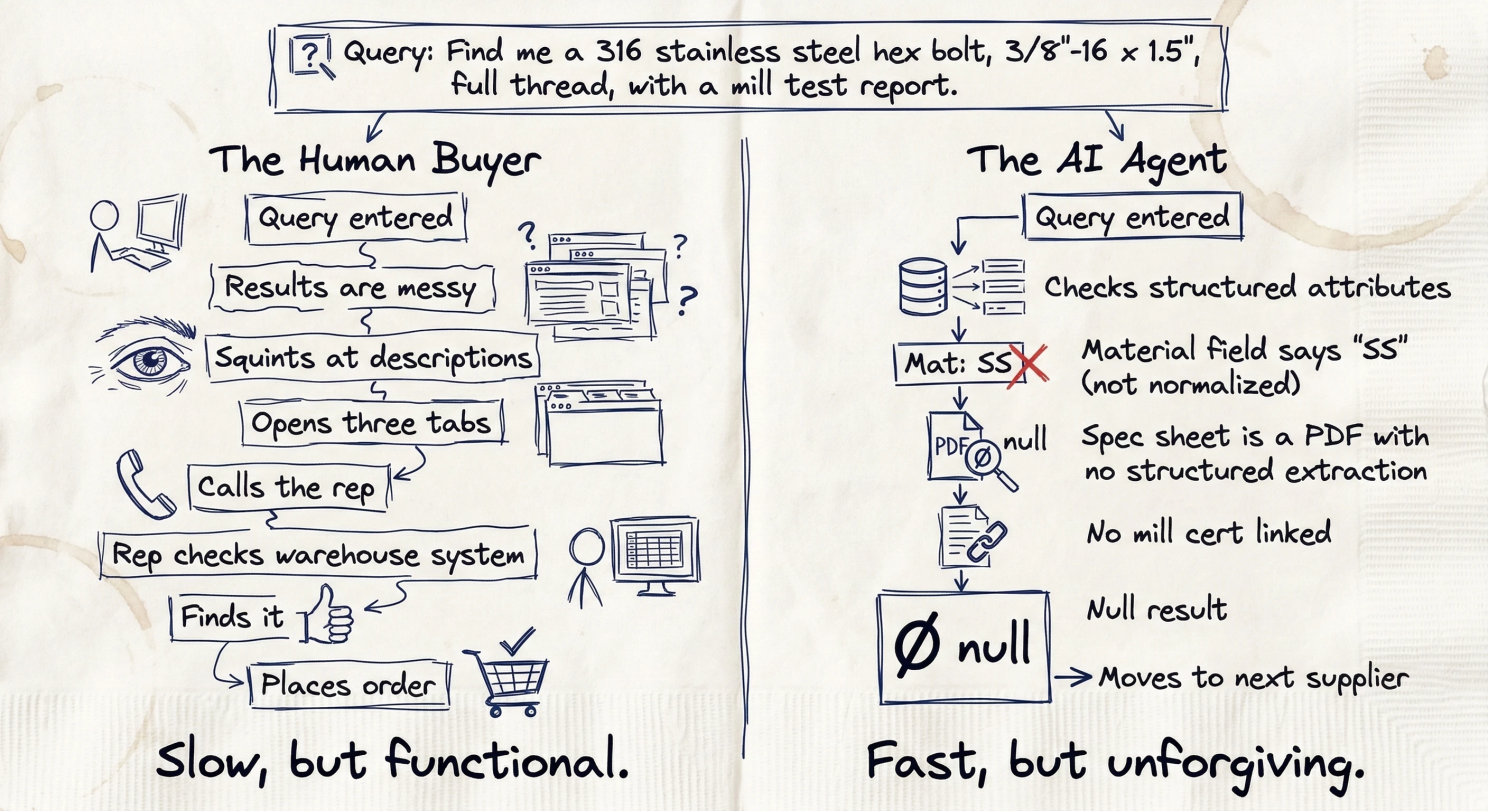
The human buyer compensates for bad data. The agent just leaves.
The new competition isn’t price. It’s answerability.
In agentic commerce, your product pages are no longer the primary interface. The interface is the question.
Will this fit? Is this compatible? Is it compliant? Can it arrive by Thursday? What’s the best substitute if this is out of stock?
So your job becomes making your catalog answerable.
Not beautiful. Not persuasive. Not even “complete.”
Answerable.
Your product data is about to become a passport
Right now, a lot of companies treat product data like a messy garage: everything is technically “in there somewhere,” if you’re willing to dig.
Agents don’t dig. Agents verify.
Think of product data like a passport: if the name is inconsistent, the photo is missing, and the issuing authority looks shady … good luck getting through the border.
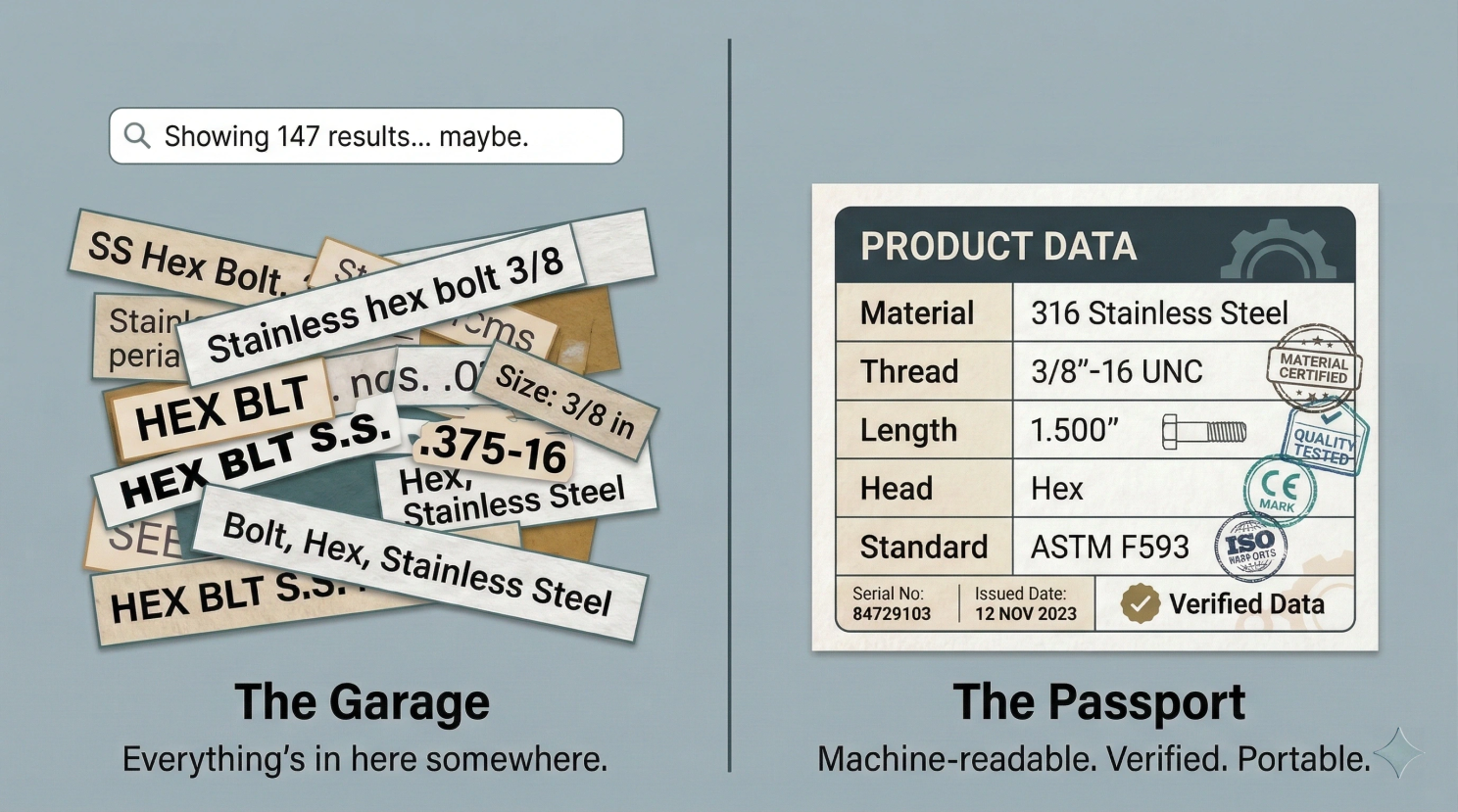
Everything’s technical in there, but that’s not the same as findable.
The 6-Layer Agent-Ready Product Data Stack
Here’s a practical framework. If your product data can satisfy these six layers, you’re not just “AI-ready,” you’re future-resilient.
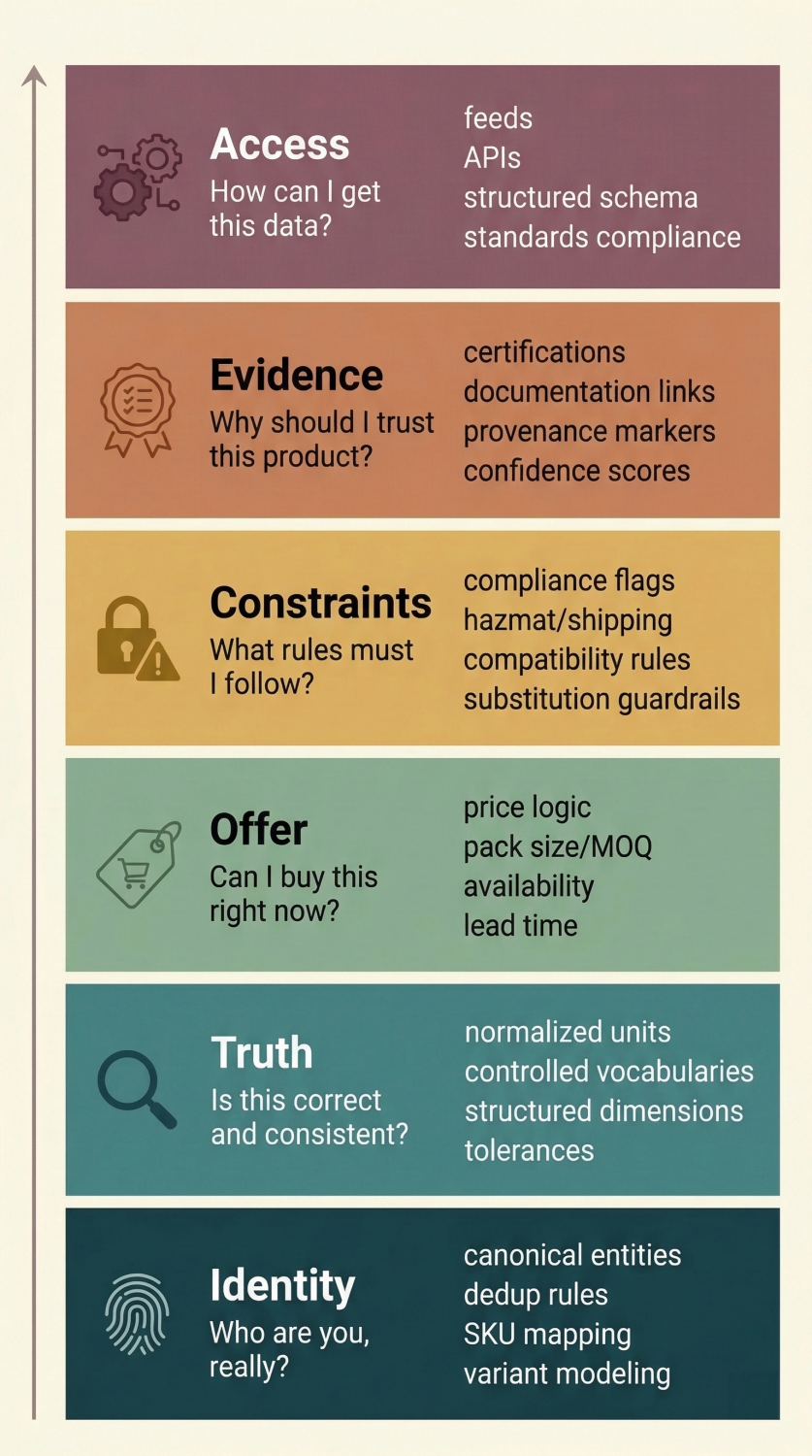
Six layers, all required. Most companies stall at two.
Layer 1 — Identity: “Who are you, really?”
Every product needs a stable identity that survives channel changes. This means canonical product entities with real deduplication rules. SKU-to-manufacturer-part-to-GTIN mapping where applicable. Consistent variant modeling, a “family” with defined dimensions, not a litter of near-duplicates bred by punctuation differences and unit inconsistencies. If your catalog has five versions of the same item because someone entered it as “1/2 inch,” “0.5in,” “.50”,” “1/2”,” and “12.7mm” … you don’t have a catalog. You have a rumor mill.
Layer 2 — Truth: “What is it, exactly?”
This is where most teams underestimate the work. Agents need normalized attributes, not poetic descriptions. Consistent units: the mm vs. inch wars end here. Controlled vocabularies: no more “SS,” “Stainless,” and “Stain-less??” as three distinct filterable values. Structured dimensions: length, width, capacity, pressure rating. Explicit tolerances and ranges where they matter. This isn’t “data hygiene”; this is making your products computable.
Layer 3 — Offer: “Can you actually sell it?”
Agents care about real buying constraints. Price logic: list vs. contract vs. tiered. Pack size and minimum order quantity (MOQ). Availability by location. Lead time, and confidence in that lead time. If an agent can’t trust your availability data, it will behave like a cautious shopper: it will prefer suppliers who can answer definitively.
Layer 4 — Constraints: “What should never happen?”
This is where B2B gets real. You don’t just want the “best match.” You want to avoid a costly mistake.
Encode constraints: compliance flags (RoHS, REACH, FDA, UL), hazmat and shipping restrictions, compatibility and fitment rules, substitution rules (“acceptable alternates”) with guardrails, environmental constraints (marine, outdoor, high-temperature).
Here’s the scenario that should keep you up at night: a procurement agent needs to substitute an out-of-stock fastener on a pressure-rated assembly. Without encoded compatibility rules, the agent selects the closest dimensional match — same thread, same length, same head style. But it’s a lower-grade alloy. The substitution ships, installs, and fails under load. The return costs more than the part. The warranty claim costs more than the return. And the customer who trusted your catalog to be smarter than a keyword match now trusts someone else.
Think of constraints as bumpers on a bowling lane: they don’t stop progress, they prevent disaster.
Layer 5 — Evidence: “Why should I believe you?”
This is the layer most people skip entirely, and it’s the one that will separate serious suppliers from everyone else. Agents are going to become skeptical little auditors. They won’t just accept a claim, they’ll look for proof. Attach trust signals to your data: certifications and standards references linked to the specific SKU, not the product family. Documentation that matches the exact variant, not a generic datasheet that might apply. Provenance markers: “manufacturer-provided” vs. “enriched by distributor” vs. “inferred by algorithm.” “Last verified” timestamps on critical fields like compliance status. Confidence scores for attributes that were inferred or enriched rather than provided at the source.
A claim without evidence is marketing. Evidence without structure is a PDF. Agents want both: structured truth with receipts.
This is where the game changes. Most “data quality” initiatives stop at completeness, i.e., did we fill in the field? Evidence goes further: can we prove the field is right, and can we show when we last checked?
When agents start making purchasing decisions with real dollars behind them, the suppliers who can demonstrate provenance and freshness will be the ones agents learn to trust. That trust becomes a competitive moat that’s hard to replicate, because it’s not about having more SKUs, it’s about having more trustworthy SKUs.
Layer 6 — Access: “Can I reach it in a sane way?”
If agents are going to operate across surfaces (e.g., chat interfaces, procurement platforms, marketplace feeds), your product truth needs to be accessible in machine-friendly formats. Feeds. APIs. Structured schema. Not just HTML rendered for human eyes. The standards work happening right now — Google’s UCP, GS1 Digital Link, the various commerce protocol proposals — is essentially the international community agreeing on what a product passport should look like. This is moving from “nice to have” to “table stakes” faster than most mid-market teams realize.
The trap: treating this like a one-time cleanup
Most companies approach product data like spring cleaning: “We’ll fix it, then we’ll be done.” However, product data is more like a garden. It grows, it decays, it gets weeds, it needs an owner who actually shows up.
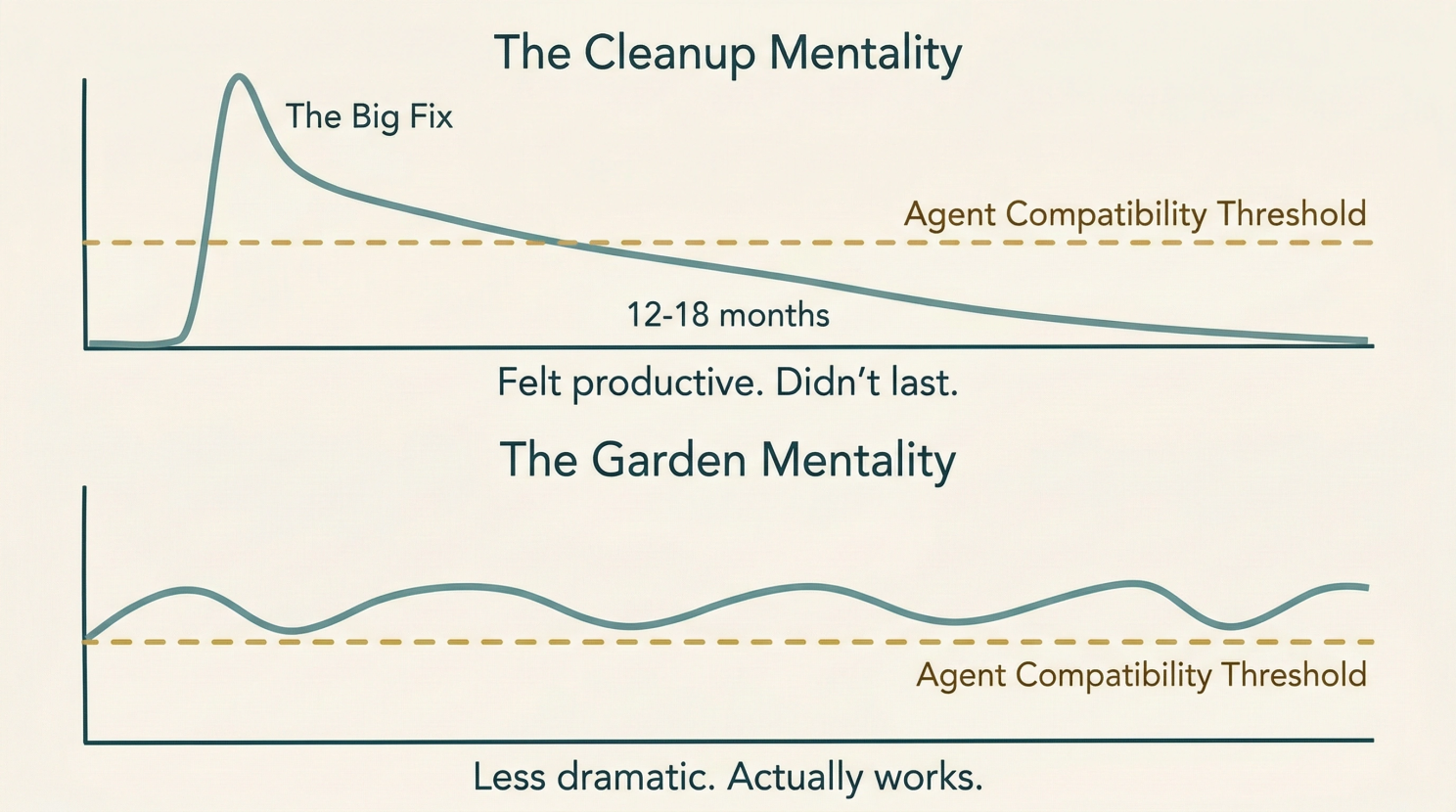
One big cleanup feels productive. A sustained operating model actually is.
The real solution isn’t only better schemas, it’s an operating model. Data owners per domain or category. Clear definitions and governance, e.g., what does “length” actually mean for this product type? SLAs for freshness on volatile fields like availability and lead times. Quality scoring across coverage, validity, consistency, and freshness. And a closed loop from failure signals — search refinements, conversion drops, returns reasons, support tickets — back into attribute fixes. When you do this, you “prepare for agents,” but you improve today’s reality, too.
B2B buyers are already deeply digital and multi-channel. The preferences have shifted dramatically over the last few years, with far more digital interactions in the purchasing journey. The agents are coming, but the humans who are already here will benefit from the same improvements.
Is your catalog actually agent-ready? A diagnostic.
Rather than a checklist you’ll skim and forget, try answering these honestly:
- Identity: If you search your catalog for a single specific product, how many records come back? If the answer is “it depends on how you search,” you have an identity problem.
- Truth: Pick a random product in a high-revenue category. Can you describe it entirely through structured, normalized attributes — no free text, no “see datasheet”? If not, that product is likely invisible to agents.
- Offer: Can an agent programmatically determine whether a specific customer can buy a specific product at a specific price, delivered to a specific location, by a specific date? Or does that require a phone call?
- Constraints: If a product goes out of stock, does your system know which substitutes are acceptable and which would be dangerous, incompatible, or non-compliant? Or is substitution logic in someone’s head?
- Evidence: For your compliance-sensitive products, can you show when each critical attribute was last verified, by whom, and from what source? Or do you just trust that “someone entered it correctly at some point”?
- Access: If a new sales channel or procurement platform asked for your full catalog in a structured feed tomorrow, how long would it take? Days? Weeks? Months?
If more than two of those made you uncomfortable, you have work to do. And the good news is: the work pays off immediately, not just when the agents arrive.
The punchline
Agentic commerce isn’t a monster under the bed, it’s a very competent assistant that refuses to work with messy instructions.
If your product data is computable, constrained, evidenced, and accessible, agents won’t bypass your catalog, they’ll keep coming back to it.
And if it’s not? They won’t struggle. They won’t complain. They won’t send you a helpful error message explaining what went wrong.
They’ll just quietly buy from someone whose data gave them a straight answer.
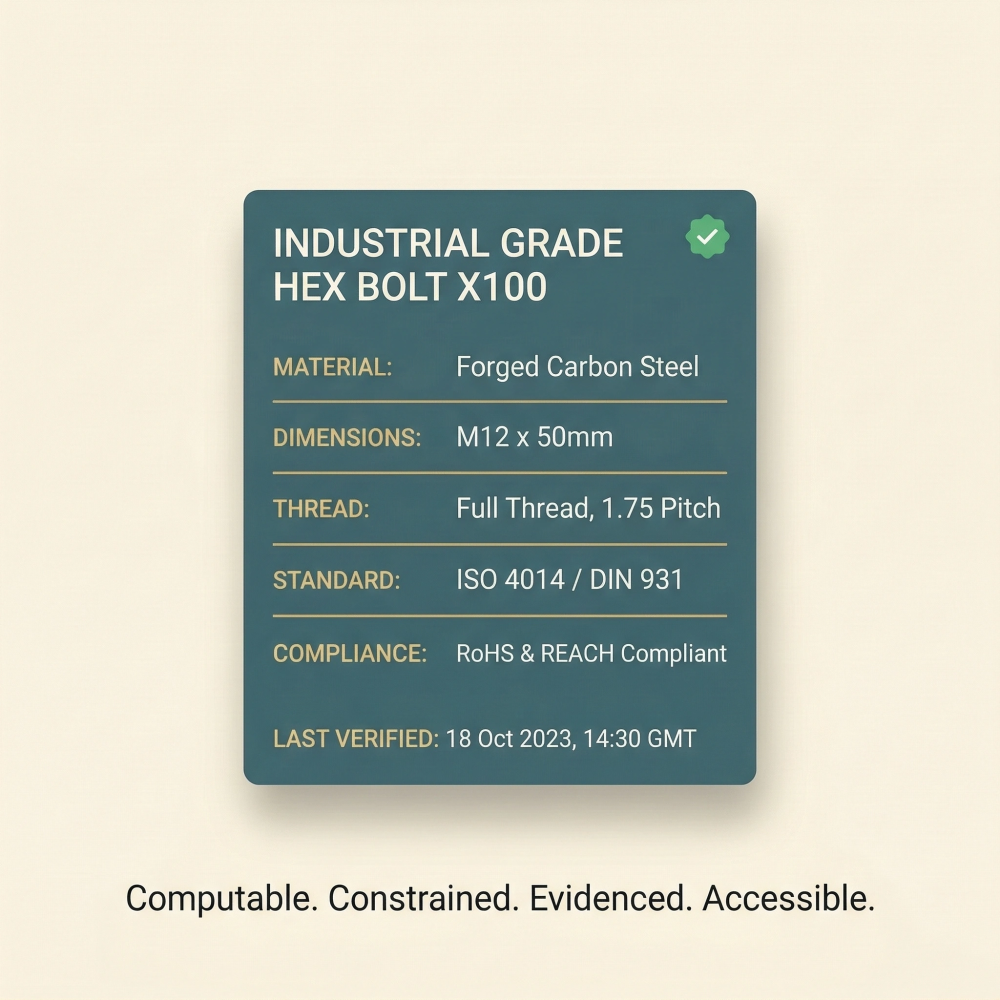
This is what agent-ready looks like. One product, done right.
Loading comments...